
Blog post

Education Technology: What is Africa missing?

African governments and stakeholders need to explore possible solutions to make the innovations of edtech more sustainable and more accessible, and therefore, more effective in Africa.

Globally, one of the first measures taken to curb the spread of Covid-19 was the closure of schools, colleges and universities.

This affected over 1,576 billion learners, constituting slightly over 91% of enrolment.

In Africa, about 297 million learners were affected. Their teachers and resources have been underutilised for a while.

In light of this, in a bid to close this learning gap and help Africa’s students to continue their academic pursuits, most of Africa has followed suit with rest of the world and slowly but surely turned to engaging its students via education technology (EdTech). This has led to an unprecedented popularity for virtual classrooms, TV, radio and online learning in Africa.

As a case in point, a long-running school radio programme set up to reach remote areas in Kenya recently got a new lease of life.

It now broadcasts nationally to over 12 million primary and secondary school learners — a jump in utilisation to over 90% from 23% in 2013.

However, even though large parts of the continent might be gradually moving towards the physical reopening of schools, it remains valid to ask, “How efficiently has Africa employed EdTech to close the education gap so far”?

Image Source: WorldRemit

This question is valid, given that online learning is likely to continue to be necessary for as long as large populations of the continent remain unvaccinated against COVID-19, and from several indications, even after the health crisis has been put firmly behind us.

Meanwhile, online learning continues through mass communication and internet-based resources. However, even within her most advanced countries, the experience is uneven for Africa.

For one, the abrupt nature of school closures ensures that about 75% of the continenet’s learners have little or no access to interactive and internet-based learning materials. Even though these materials are open access, they are largely unreachable due to connectivity-related challenges.

Be that as it may, while the main focus at the moment is rightly on providing learning opportunities to the already reached population of students, attention must also be given to the vast majority of African students whose educational pursuits have been effectively upheld y the pandemic.

Even those among them whose schools are gradually churning out feasible arrangements for physical resumption still lag behind their peers within and outside Africa whose education was successfully salvaged in the interim via edtech.

Subsequently however, African governments and stakeholders will need to explore possible solutions to make the innovations of edtech more sustainable and more accessible, and therefore, more effective in Africa.

The response so far

Unesco’s most recent assessment shows that EdTech tools are considerably common in middle-income African countries and reach many students. While some of these tools require a subscription, the majority offer free access.

However, a majority of the tools require internet connectivity, leaving students in areas with little or no internet access at an automatic disadvantage.

Also, the education technology products available to education systems and schools come with different capabilities, and education managers will have to use their discretion to determine what is feasible in their own contexts.
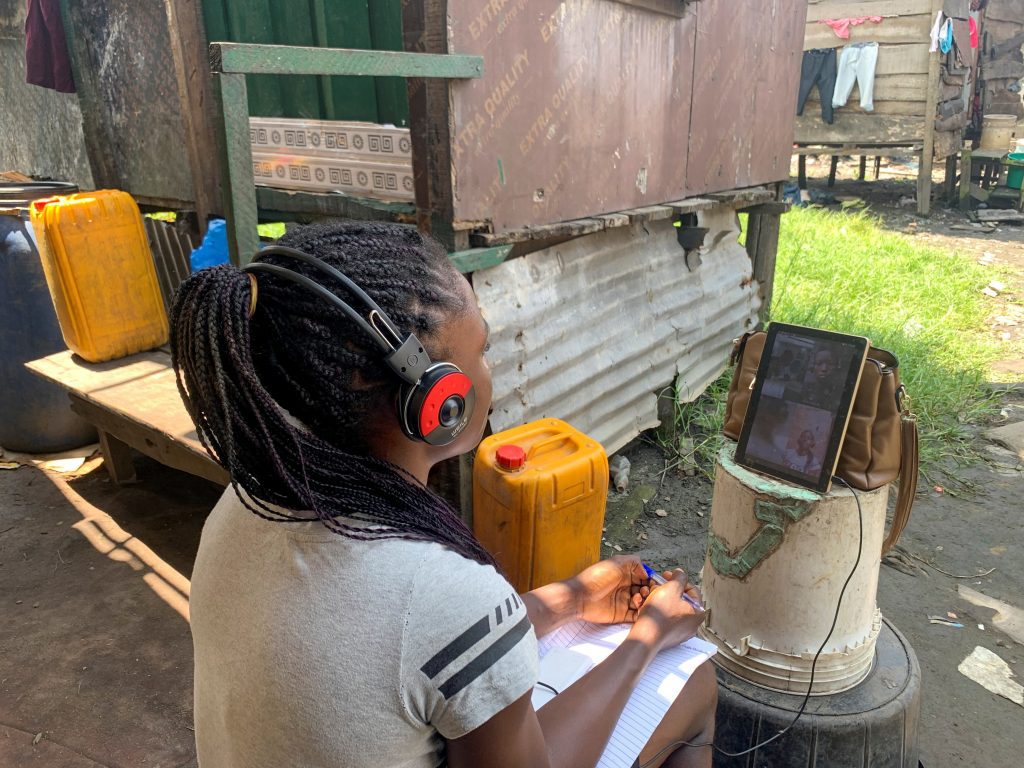
Image Source: UNESCO

It is the reality, that at the moment, the effectiveness of educational technology depends on the strength of national networks and connectivity to technology. That practically determines the extent of use that the internet service providers and the devices at the disposal of schools, parents and learners, can be of to the students’ studies.

Putting it together, internet penetration in Africa stood at 39,3% of the total population compared to the rest of the world at 62,9% as at March 2020.

This undoubtedly means that, in all their executing, African governments must execute successful projects to close these internet connectivity gaps within their borders.

Another point of emphasis in boosting edtech in Africa would also be to increase the accessibility to smartphones in Africa. A 2017 survey showed that smartphone penetration was at 51% in South Africa, 30% in Kenya and 13% in Tanzania. These are all grossly inadequate rates for a continent intent on educating its (youth) population at anything close to the current global pace.

In some countries such Ghana and South Africa, smartphone and internet penetration seem to go hand in hand, but for other countries such as Kenya, Nigeria and Senegal, internet penetration is ahead of smartphone penetration by leaps and bounds.

Final Notes

The Covid-19 crisis, for as long as it lasts, presents an opportunity to strengthen education technology in Africa. This could ensure less reliance on on-campus instructional delivery and create an ecosystem that allows learners in both public and private institutions to access digital learning materials.

A good way to do this is by making smartphones more accessible to more people by, for example, zero-rating smartphones and providing subsidised WiFi in low resource areas.

This would fill the digital divide gap created by the inability to pay for internet services and increase access to internet devices to match internet penetration.

Technology and digital solution developers, information service providers and governments will also need to join forces with other education stakeholders to close the technological learning gaps sooner than later.

The pandemic also gives rise to the need to design and provide alternative contextualised cost-effective learning delivery channels that would outlive Covid-19.

These could address some service delivery gaps pre-dating the crisis, including the weak mechanisms to reach those furthest left behind, special needs children and managing the cost of schooling.

Share:

LinkedIn
Facebook
X
WhatsApp

Board of Trustees

Dr. Waheed Awonuga

Member, Board of Trustees

Waheed Oyetola Awonuga is a trained Medical Doctor with five years of ongoing practice experience, specialising in Family Medicine. He is also an entrepreneur with a knack for developing ideas that are not only bankable but profitable.

Waheed attended Santa Maria Private School in Mushin and Government College Ikorodu. He holds a Diploma in Data Processing from Olabisi Onabanjo University and completed his medical education at the University of Sierra Leone, graduating with MBChB (Medicine and Surgery). He passed the West African College of Physicians Primaries Examination at UCH, Ibadan.

Waheed is an alumnus of the Young Africa Leadership Initiative (YALI), Africa Cohort 2. He owns Infinity Creative Media, a media consultancy firm in Freetown, Sierra Leone, and Infinity Print House, a general print firm also based in Sierra Leone.

Waheed is an avid reader and writer who enjoys travelling and spending time with his family.

Management Team​

Hon. Tobi Olatunji

Executive Director

Hon. Tobi Olatunji serves as Executive Director of Teens Going for Gold Network, providing strategic leadership across TGFGN’s programmes and institutional partnerships.

He oversees programme delivery across all five active states and drives the organisation’s evolution into an institutional peace education body, ensuring that TGFGN’s work remains responsive to the complex social realities facing Nigerian youth today.

Management Team​

Ola Olaoluwa

Co-Founder

Olawumi Olaoluwa is a graduate from the Economics department of the University of Benin, Nigeria. He is also the Creative Director of JOSEL kolektionz, a clothing line.

Vocationally, he is a writer, content developer, actor, and leadership enthusiast. One of the pioneer volunteers of Teens Going for Gold Network, Olawumi has over five years of experience in teen mentoring and coaching. He currently serves as Director of Human Resources.

In his own words: “The opportunity Teens Going for Gold Network presents me with to impact teenagers with qualitative and sustainable education is the main attraction the organisation holds for me.”

Board of Trustees

Dr. Mala Mustapha

Member, Board of Trustees

Dr. Mala Mustapha is an academic and development professional with deep expertise in conflict resolution, peacebuilding, and institutional governance.

His scholarly and practitioner experience spans multiple Nigerian states and regional contexts, providing TGFGN with critical insight into the structural dimensions of peace and security in Northern Nigeria and the Lake Chad Basin region.

Board of Trustees

Idayat Hassan

Chair, Board of Trustees

Idayat Hassan is a leading expert in security, governance, and democracy in West Africa. She serves as the Director of the Centre for Democracy and Development (CDD), one of the region’s foremost policy research and advocacy organisations.

Her work spans election monitoring, conflict prevention, and democratic institution building across Nigeria and the broader West African sub-region. She brings decades of governance expertise to TGFGN’s Board of Trustees.

Management Team​

Godsgift Chayil Obi

DEPUTY DIRECTOR

Godsgift Chayil Obi serves as Deputy Director of Teens Going for Gold Network, supporting organisational management, programme coordination, and operational delivery.

In this role, she works closely with the Executive Director and management team to ensure that TGFGN’s programmes achieve their intended impact across all active states, maintaining the quality and consistency of delivery that has defined the organisation’s 12-year track record.

Board of Trustees

Dele Olomide​

Member, Board of Trustees

‘Dele Olomide currently leads the Human Resources and Admin function of Clarke Energy Nigeria, the largest authorised distributor and service partner for Jenbacher gas engines and a leading brand in the power and utility sector in Nigeria. His interests are Leadership Development, People Development (Coaching and Mentoring), Organisational Development and Change, Strategy and Growth.

‘Dele is an HR professional with approximately 10 years of generalist experience spanning Manufacturing, IT, Gaming and Energy. He is also an Associate Pastor with El-Shaddai Covenant Church, Lagos. Before now, he has worked with two multinationals, three start-ups, and a Secondary School.

He graduated from the University of Ilorin where he studied Mathematics/Statistics and holds an MBA in Marketing Management. He is an Associate Member of the Nigerian Institute of Training and Development and an Associate Member of the Chartered Institute of Personnel Management.

Board of Trustees

Adedolapo Osuntuyi

Member, Board of Trustees

Adedolapo Osuntuyi is a children and education advocate. She is the founder of Dolly Children Foundation, a nonprofit organisation that equips the African Child to adopt twenty-first-century skills through education, capacity building and advocacy programmes.

Inspired by her upbringing, she has a passion for empowering and creating equal opportunities for children from low-income backgrounds. Dolapo has developed organisational strategy and management processes in the Foundation that have impacted over 22,000 children in 25 communities in four states.

Dolapo has over a decade of experience in child protection, early childhood and community development programmes. A graduate of Botany from Lagos State University, she also holds a master’s degree in Child Health and Social Care from the University of Central Lancashire, Preston, United Kingdom.

In 2015, she received an Africa-America Institute Scholarship to study Social Sector Management at the Enterprise Development Centre, Pan-Atlantic University, Nigeria.

Board of Trustees

Adebanke Ilori Oyeniyi

Secretary, Board of Trustees

Adebanke Ilori Oyeniyi is a lawyer and development professional. Her professional experience spans across politics, inclusive governance, and legislative reforms. She serves as the Executive Director of Raising New Voices Initiative and as the Managing Editor of Lawyard, a platform for interactions around the practice of law in Nigeria.

In 2019, Adebanke led New Voices to conduct the national #BreakTheHold campaign providing resources to competent young people under 35 contesting to be members of the Federal House of Representatives. As a woman in politics, she was appointed as the National Publicity Secretary of Kowa Party — making her the youngest female to occupy the position in Nigeria.

As an advocate for social equality, she has championed the right of prison inmates to education in line with the UN Minimum Standard Rules for the Treatment of Prisoners, and has worked for the implementation of laws to promote the rights of children and prevention of violence against persons.

As a Pan African, she has facilitated extensive deliberations at the African Union on the importance of youth integration in the actualisation of Agenda 2063.

Adebanke holds a bachelor’s degree in law from Obafemi Awolowo University, Ile-Ife, a Certificate in Public Management from Bridgewater State University, Massachusetts, and is pursuing her Master’s in International Development and Policy at the University of Chicago. She is a 2019 Mandela Washington Fellow.