20 years after then South African president, Thabo Mbeki appointed the Jali Commission to investigate and report the irregularities in the South African prison system, improvements are finally kicking in.
And Westville prison, with the most successful prison-school programme in the country, is a beautiful case in point.
A recent visit saw a group of young pupils frantically trying to solve an intricate mathematics problem on the classroom board. The teacher looks on, only intervening to remind the learners of the formula he had taught them. Finally, Nhlakanipho Luthuli, 20, gets the correct answer and the class applauds.
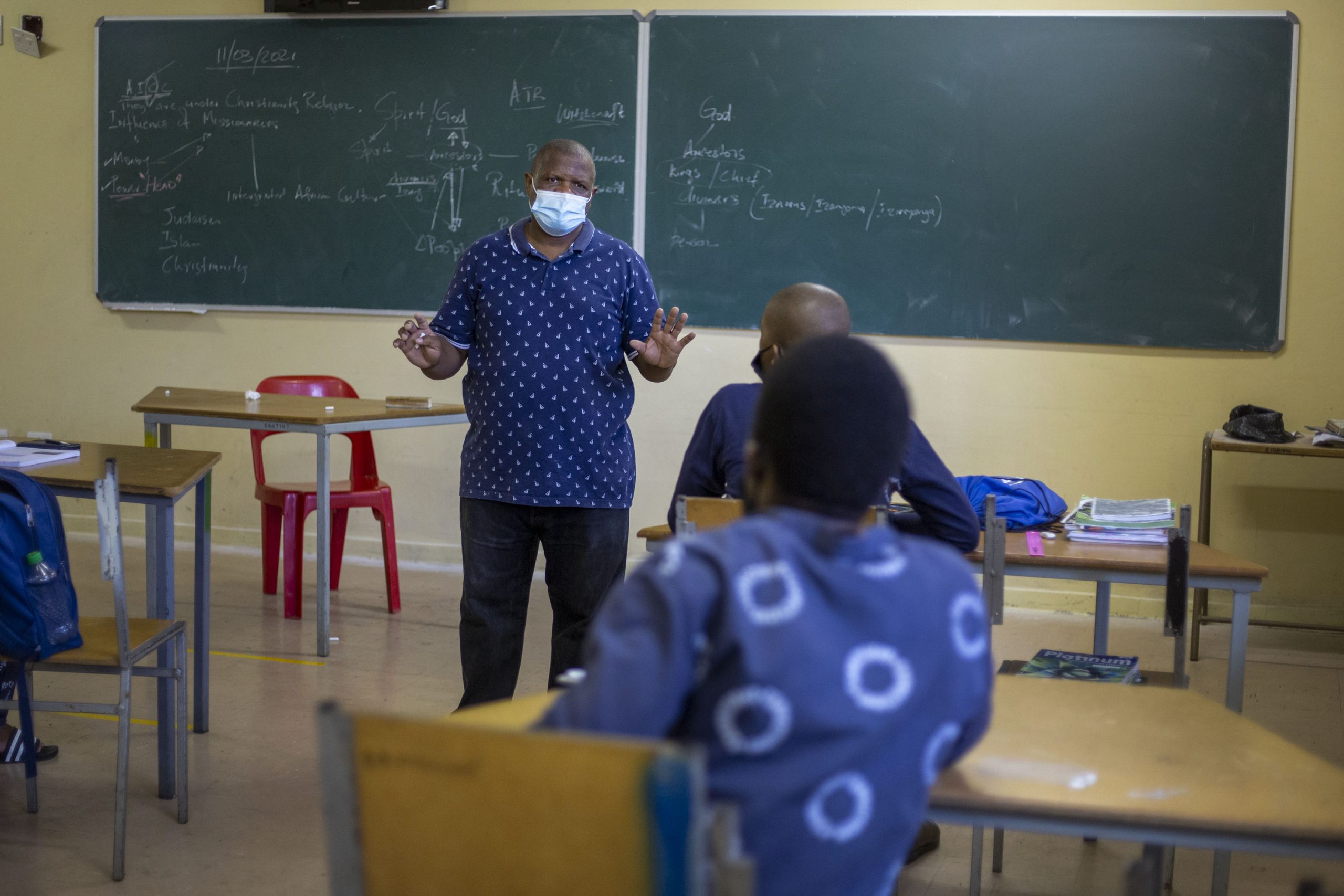
The discipline and earnestness of the learners make it seem like a regular school, except that all here are in blue clothing, the uniform for juvenile prisoners. In the room next door, armed male warders keep a watchful eye on happenings in the school.
This is Usethubeni School at the Durban Westville Youth Correctional Centre. The centre is part of Westville prison, one of the largest correctional centres in South Africa. It has several wards, including a maximum-security unit, a medium-security unit and a juvenile unit that houses youngsters between the ages of 16 and 25.
Usethubeni school
The Department of Correctional Services says a quarter of the about 140 000 inmates it has are juveniles.
The Usethubeni School is one of the department’s 17 prison schools for juvenile offenders. These schools allow young offenders to continue their education while behind bars.
Prisoners in these schools are housed in cells separate from the main centre “in order to ensure that they are not easily disrupted by the general inmate population”, according to the department.
This year there are 198 pupils enrolled at the Usethubeni School. In previous years, the number reached as high as 300. Classes at each level are divided into two academic streams: general and commerce. There used to be a Computer Aided Teaching (CAT) stream too but it was abandoned recently when the school failed to get a teacher dedicated to the subject. As a result, their fully equipped CAT class fell into disuse.

Usethubeni is the best performing of South Africa’s juvenile prison schools, attaining a 100% Matric pass rate in the past five years. The matric class of 2020 did very well, with all the students gaining Bachelor passes, which allowed them to enrol at university to continue their studies.
Many of those who have been paroled have since enrolled with tertiary institutions to further their studies. Those that are still inside are carrying on with their studies at the University of South Africa through correspondence.
Luthuli said he is gunning for at least five distinctions. “I’m confident that I can achieve this feat and go further to study BCom or actuarial studies,” he said.
He shares a cell with 17 other pupils, all in matric. They study well into the night so they can emulate former Usethubeni pupils’ successes.
Luthuli, who is from Umlazi in Durban, says he wants to show society that he is a “changed man” by using his prison term to gain professional knowledge. His ambition is to start his own business and employ people.
In 2014, while drunk, he fought and stabbed a love rival who died on his way to the hospital. The following year Luthuli was sentenced to 20 years in prison. He will be eligible for parole only in 2024.
In the next class, Siphiwe Mbambo, a teacher who doubles as the pastor, was busy taking his eager and attentive pupils through religious lessons. The topic on this particular day was “African Traditional Religions and Beliefs”.
Mbambo said he taught in three out-of-prison schools before coming to Usethubeni to “change souls”.
“Since arriving here more than 10 years ago I’ve seen many young hardened criminals turn their lives around. Some have gone on to become professionals and important people in society,” he said.

Success stories
Sipho Ndaba (not his real name) is one of a number of successful former pupils the school calls upon to motivate current pupils. In 2006, he sat for his matric examination and passed every subject with a distinction. These subjects included Maths and Accounting.
The South African Institute of Chartered Accountants was so impressed with his results that they formally paid for all his studies at the Nelson Mandela University in the Eastern Cape, where he finished with honours in BCom, and in the minimum time. He is now a chartered accountant and owns an estate agency with 10 full-time employees.
He is reluctant to give his name “because of the nature of our business and the fact that we handle properties and millions of rands belonging to clients. Some people would not be comfortable with leaving these resources in our hands once they know my background.
“But I go around to motivate young people who are in conflict with the law and those from disadvantaged communities. I tell them to look at how I was able to change my life,” Ndaba said.

Siyabonga Mlotshwa (also not his real name), 29, is another former pupil who is called upon to motivate pupils. He holds a Masters degree in Marketing Management and will soon be conferred with a PhD. He studies part-time and lectures at Mangosuthu University of Technology (MUT).
It is a life very different from the one he led before. He was arrested in 2007 after a botched robbery at a house in Scottburgh, on the lower South Coast, and sentenced to more than five years. He said peer pressure and lack of proper guidance led him to a life of crime.
“I was in grade 11 when I was arrested and when I entered the prison system I focused all my energies on studying and realising my dream of making something out of my life,” he said.
He added that some of the people he was arrested with went back to a life of crime and died. And he has lost touch with those still alive.
‘Students rather than prisoners’
The school’s principal, Nelly Mkhize, started teaching at the school when it was established in 1996. It started out as a part-time school facility and only became a fully-fledged school in 2000.
She credits the dedicated team of teachers, and pupils themselves, for the remarkable achievements.
“We are not just teachers here, we see ourselves as parents. It is important that we treat these lads as pupils rather than prisoners. Once you show them respect, they respond in kind.
“I have seen some of the pupils who had a reputation as rough and loud-mouthed. But once they come here we calm them down. It also helps that we try and meet and engage their parents so that we can understand their personalities,” she said.
She often has to use money from her own pocket to buy toiletries and other essentials for her pupils, especially those who are orphaned or don’t have family members who visit them.

Norma Ngcolosi, who is the head of the school’s foundation phase, echoed Mkhize’s sentiments, saying lifetime bonds are built between teachers and pupils.
She said some of the pupils who enrol at her school do not know how to read or write. “Before I arrived here I never imagined that South Africa still has the problem of illiteracy, but here I saw it with my own eyes. We have to take them through their paces and it is not often easy because some of them are well into their teens.
“If I were to be asked whether to return to the normal outside school or teach here I will choose to teach here. It is because here pupils know what they want. Many of these children are here because of broken homes, dependence on drugs and/or alcohol.
“Once in prisons, they clean up because they don’t have access to these substances. Their personalities return and then you see their hidden skills and creativity blossoming,” she said.
Be that as it may, the school has not completely escaped the bane of gang and gangsterism that prison society is known for.

Problems remain
Last year a matric pupil was hospitalised after being stabbed by a gang member in the prison for refusing to take orders from the gang. This happened after he decided to quit gang membership because he was due for parole.
“But after he recovered from his injuries he resumed his studies and passed his matric,” said Ngcolosi. He was later released on parole.
The Judicial Inspectorate for Correctional Services (JICS) is an independent body that facilitates the inspection of correctional centres and reports on the treatment of inmates and the conditions under which they live.
Over the years the inspectorate has reported on the brutality of life in prison, including violence and abuse meted out by warders on prisoners and by prisoners among themselves.
Edwin Cameron, the former Constitutional Court Justice who has headed Jics as the inspecting judge since January 2020, said he could not comment on prison violence as he was still fairly new in the position.
However, Cameron’s spokesman Cupido Emerantia said: “The realities and difficulties in correctional centres are no different for young offenders. The circumstances and the environment remains the same for everyone young or old who are incarcerated. There are young offenders (like adult offenders) who assimilate into a gang lifestyle and those who choose to concentrate on furthering their education.
“Those who, for example, get involved in drugs or gangs find it ultimately more difficult to return back to society, compared to those who have concentrated on furthering their education and/or training.”
The South African Prisoners’ Organisation for Human Rights (SAPOHR) says the South African prison system is no different from that under apartheid and most of the young people jailed do return.

Miles Bhudu, a SAPOHR spokesman, said: “Prison, for young and adult prisoners, is hell. The veil of secrecy of life is still the same today as it was in the 60s, the 70s, the 80s and 90s, nothing has changed. It seems like they just inherited the place from the apartheid and changed the name from prison to correctional service centres. But very little rehabilitation takes place there.
“The few schools that are in our prisons are just inadequate. We live in a country with too much poverty, crime and violence. To rehabilitate young people who are in conflict with the law they have to change the whole set-up of juvenile prisons to truly rehabilitate young people and ensure that they don’t join gangs and become repeat offenders,” Bhudu said.
Other skills
At the Westville juvenile facility, young offenders who are not academically inclined are given a lifeline in the form of technical and vocational learning. This section teaches skills such as plumbing, building, upholstery work and others.
Kaplan Luthuli (not related to the pupil) heads this section. He said they often use clay to teach learners the skill of bricklaying because pupils cannot be taken out to building sites.

“These pupils are eager to learn but we can only do so much because of lack of resources. But despite this there are many master builders who learnt their trades here in prison, under my supervision,” he said.
Luthuli said they plan to have lecturers of the local technical and vocational colleges teach at the prison, and are in the final stages of negotiations.
Singabakho Nxumalo, the department of correctional services’ spokesperson, said they view Usethubeni School as a good example of how education can help in rehabilitating offenders, preparing them to reintegrate with other members of society.

“At no point as the country must we ever doubt the importance of education in building safer communities. Those who opt to substitute schooling for a life of crime should know that schooling is also at the heart of rehabilitation in correctional facilities. Such should never be an option but mandatory.
“For inmates to take responsibility for their future, their time behind bars must then be purposeful. Hence, we have intentionally made education a pillar of rehabilitation and we must rigorously make it impossible for some to escape education,” Nxumalo said.
Pietermaritzburg-born Msizi Mchunu, 21, is in this year’s matric class, in the commerce stream. He is due for parole next year. It was a sexual assault that got him convicted and jailed.
“I could have chosen to join the gangs inside here. In prison, no one is forced to join the gang but you are enticed with cigarettes and other goodies to join. If you are weak, you fall for it. But I opted for education. I’m determined to pass with flying colours,” he said.
This article was first published by Chris Makhaye for New Frame.
